
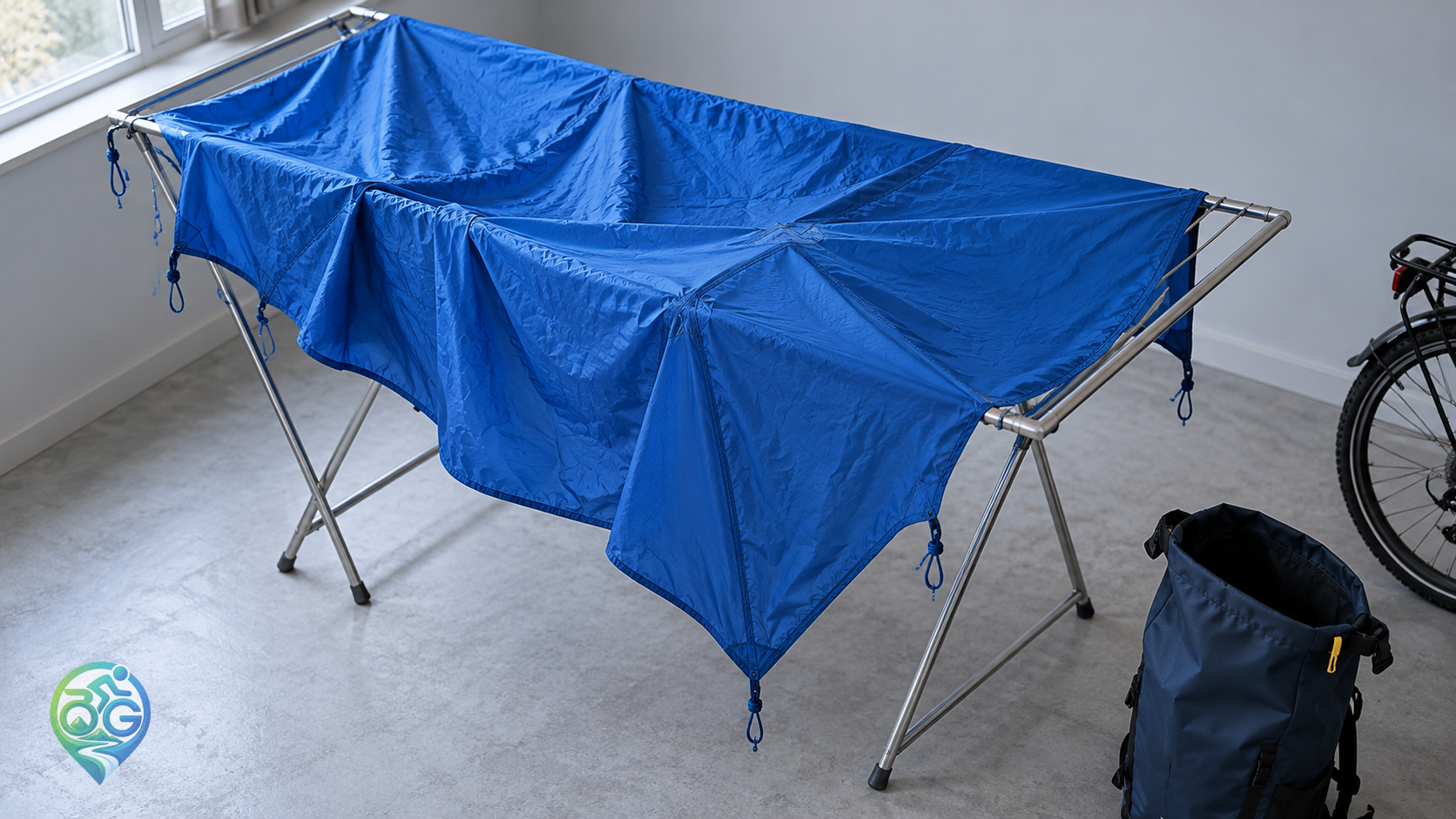
A tent packed tightly for the ride home still needs to be opened before it goes into storage. The neat bundle hides the floor, folded corners and carrying sack, any of which may still be damp. Learning how to store a tent after bikepacking starts with inspecting those separate parts. Give the shelter a suitable place between trips, rather than leaving it in the shape that happened to fit the bicycle luggage.
Make the storage decision with the tent unpacked
Choose a clean surface or an appropriate airing space, then open the body, flysheet and any separate footprint. Keep pegs and pole ends away from the spread fabric. Use the model's own component list to establish what should be there. Your wider bikepacking gear checklist can record a missing part, but cannot replace the particular tent's inventory.
NEMO's tent-care instructions call for every component to be completely dry before storage. Open damp folds so the surfaces are not held against each other. Remember the carrying sack if it travelled with wet fabric. A dry upper panel is only one part of the assessment, not evidence that the whole shelter is ready to put away.
Allow the details to catch up
Terra Nova's maintenance FAQs identify webbing, zips and the elastic cord inside poles as details that may take longer to dry. Check those as well as the floor and corners, following the model's instructions. Conditions vary; a fixed drying period is less useful than establishing that the components are actually dry.
Keep an airing arrangement that avoids damaging the cloth. NEMO describes drying in indirect sunlight and cautions against prolonged exposure to direct sun. If the available room or outside space is still damp, do not close the fabric into a compact bundle merely because the planned drying time has elapsed. Recurring moisture inside during camping needs a separate look at tent condensation; this after-trip inspection is concerned with the condition in which the shelter will be stored.
Use the open fabric to spot unresolved damage
REI's care guide links damp storage with mildew and coating deterioration, and describes sticky, flaking or unpleasant-smelling fabric as needing further attention. Record a suspect area instead of assuming that a tent put on a shelf will be ready for the next journey. Establish the appropriate maintenance or service route for that model before relying on it again.
If cleaning is necessary, follow the manufacturer's directions for the material and coating. Do not combine different brands' cleaner recommendations into a universal recipe or experiment with household solvents. Both NEMO and REI advise against machine washing and machine drying the tent. Finish the drying stage after any cleaning; a clean shelter still has to meet the same dry-storage requirement.
Give the dry shelter room between trips
MSR's storage advice favours an oversized breathable cotton bag or mesh duffel over the small stuff sack, and gives a suitably sized pillowcase as another option. NEMO recommends loose long-term storage in a cool, dry, dark place. Apply those principles alongside the instructions for your own shelter, rather than assuming every model needs an identical folding pattern.
Assess the location as well as the container. A damp wall, a sunny balcony or a hot vehicle boot is a poor substitute for a suitable shelf simply because there is space available. Arrange hardware in its protective bags so sharp ends do not bear against the fabric. Keeping all components together need not mean compressing them into one small travel sack.
When the next departure is scheduled, return to the missing-part and damage notes. Include a practice pitch in your long-distance ride preparation, confirm that the recorded issues have been addressed, and account for the complete set of parts. Move back into the compact carrying sack after that check. The first campsite of the trip is an inconvenient place to discover that the unresolved note still matters.
Discussion & Comments 0
Share your thoughts, gear experiences or ask questions about this guide.
No comments yet.
Be the first to share your thoughts!
Join the Discussion
Log in with your Bisikletli Gezgin mobile account to participate in discussions and track your contributions.