
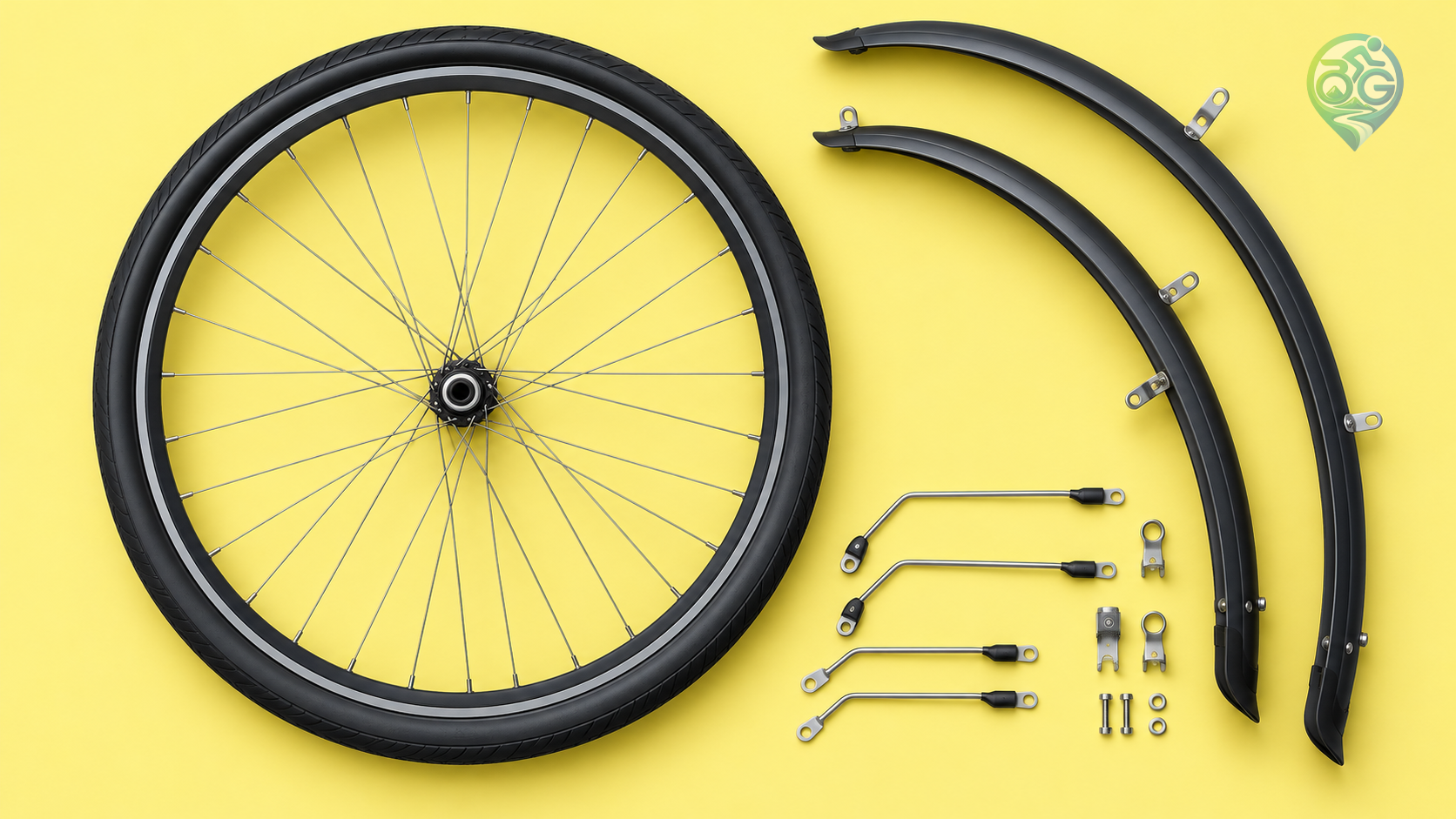
Send the shop a precise fit question before ordering: the bicycle model, the tyres currently fitted and the full product code of the mudguard set you want. “Will these fit a gravel bike?” leaves too much open. A bicycle mudguard fit check needs to establish where the guards will attach and whether there is room for them around the actual wheels, rather than matching a wheel-size label alone.
Ask about the complete installation
Decide whether you want guards that stay on the bicycle or a removable arrangement. Then ask what that particular product needs: existing eyelets, straps, approved clamps or a model-specific adaptor. Do not assume that a front and rear set includes every fitting needed by your frame. Ask for any additional parts by code, so a missing bracket does not become an improvised solution halfway through installation.
Show the shop the bicycle as you use it. Include the brake calipers and rack fittings in your photographs. If you normally travel with luggage, show the rack and bag arrangement too. A fit discussion conducted with an empty frame can miss the other accessories you intend to retain. These pictures help the conversation; they do not replace checking the parts on the bicycle.
Keep the proposed solution specific. Ask whether the fitting is approved for the frame or fork material and the exact guard. Avoid drilling the bicycle, altering brake attachments or substituting an unverified clamp to make an unsuitable purchase work. If the mounting arrangement remains uncertain, take the bike to the shop before buying.
Read width and clearance as different questions
The width printed prominently in a product name may describe the guard profile rather than its maximum permitted tyre. Find the specification for the selected variant and compare the code with the item being supplied. A photograph reused across several widths cannot identify which one is in your basket. Keep a copy of the relevant instructions with the order details.
In its mudguard buying notes, SKS considers geometry, mounting, wheel and tyre dimensions, racks and brake type. Treat a general buying recommendation as a starting point. Obtain the current installation requirements for the actual guard and bicycle instead of turning one manufacturer's general advice into a universal gap measurement.
The April 2026 Trek owner's manual explains that tyres carrying the same size marking can have different installed, inflated widths. It also says accessories such as fenders may require additional clearance. Check the actual setup against the relevant manufacturers' requirements; do not use the accessory if its specified clearance cannot be maintained.
Look at the restricted places
A generous-looking gap on an open section of the wheel does not settle the fit under the fork crown or around the rear bridges. Ask which views and measurements the shop needs. Remember that the guard and its attachment occupy space too. Checking an inflated tyre without that hardware in place is only part of the assessment.
If a tyre change is planned, settle it before finalising the guards. Use the gravel tyre selection guide to clarify the width and tread you actually intend to ride, then have the combination assessed. A photograph of today's narrower tyre cannot approve tomorrow's installation. When both components are changing, request a check of them together.
Identify the safety parts before accepting the job
On systems equipped with it, SKS describes ESC as a stay release mechanism: its interlocking mounting parts separate under heavy load to reduce the risk associated with an object caught at the front wheel. That explanation concerns the ESC system. It does not establish that every guard has it or guarantee that a wheel cannot jam.
Ask the fitter to identify the safety components on your particular set. Do not tie a release fitting permanently closed or replace it with a rigid connection contrary to the instructions. Keep the correct spare-part details available if a piece is later damaged or lost. An unfamiliar plastic fitting should not be dismissed as packaging merely because it looks less substantial than a metal bolt.
Before accepting the installation, resolve rubbing, loose parts or unexplained noise. Get the agreed bicycle, tyre and guard codes recorded with the fitting arrangement, rather than relying on a broad claim that the set suits all road bikes. The separate wet-weather riding guide covers clothing, visibility and braking preparation. Here the purchase is ready when the shop can explain which parts fit your bicycle and how the required clearances and attachments have been checked.
Discussion & Comments 0
Share your thoughts, gear experiences or ask questions about this guide.
No comments yet.
Be the first to share your thoughts!
Join the Discussion
Log in with your Bisikletli Gezgin mobile account to participate in discussions and track your contributions.