
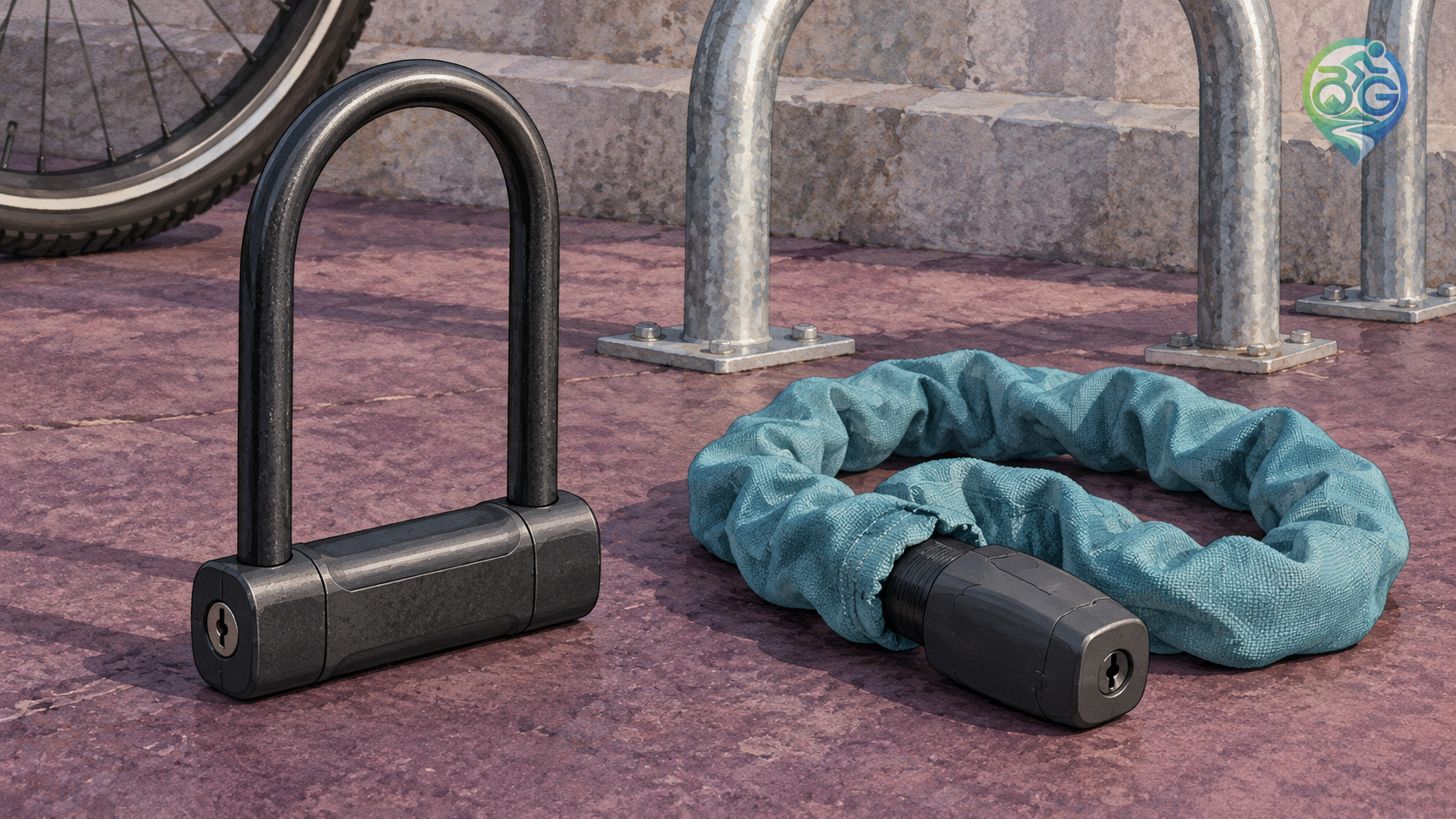
If the front wheel came off, what would still be attached to the stand? That question is a useful starting point when learning how to lock a bike. A closed lock can secure one component while leaving the rest of the bicycle outside the connection. Follow the actual path through the frame, wheel and anchor before you walk away. With two locks, assign each a job instead of placing both around whichever part is easiest to reach.
Build the connections around the frame
The frame belongs in the main connection to a fixed object. Locking a wheel to the frame alone leaves the complete bike portable; locking only a wheel to a stand leaves the frame outside that connection. Those are different mistakes, even though both arrangements may look tidy from a distance.
Police.uk's bike security guidance recommends two quality locks, including at least one D-lock. This article deals with arranging the locks you have. For decisions about size, carrying options and product selection, use the separate bike lock buying guide.
Give each lock a clear role
One workable arrangement appears in Kryptonite's proper lock-up instructions: the first lock connects the frame and rear wheel to the immovable object, while the second connects the front wheel to the frame. The front wheel then joins a frame that is already anchored. Trace each closed loop separately rather than judging the arrangement by the number of locks visible.
That example depends on the equipment fitting. The lock opening, wheel size and position of the stand must allow the intended parts inside. Do not force a lock shut against a brake hose or cable to reproduce a diagram. If your second lock also reaches the stand, check that it still captures the intended wheel and frame rather than merely adding another loop around the parking furniture. A short lock in the wrong place does not acquire a useful connection by being pulled tighter.
Change the parking position when the locks cannot reach
An inverted-U stand can allow the frame to sit beside the anchor, but inspect the actual installation. Check whether it is firmly fixed, already damaged or open in a way that would let the locked bicycle lift over it. Choose another anchor if its condition is doubtful. Leave doorways, pedestrian space and accessible routes clear; the nearest railing is not automatically an appropriate bicycle parking place.
Before closing either lock, position the bike where the intended connections can be made. Reduce unnecessary space inside the lock and keep it off the ground, as the manufacturer advises. The Sold Secure bike security guide also illustrates securing the frame and wheel to a stand. If a crowded rack prevents that arrangement, moving to a different stand is more useful than leaving the frame outside the lock.
Visibility matters too. A well-lit location with people passing is preferable to an isolated corner, but neither passing traffic nor a camera guarantees protection. For an overnight stop, ask who can enter the storage area and when it is closed. Put those questions into your cycling accommodation enquiry before treating a courtyard or room as your planned parking place.
Separate the things you lock from the things you carry
A frame lock-up does not secure detachable lights, a cycle computer, phone or luggage. Take easily removable items with you and keep the keys with you as well. A key left in a bag on the bicycle defeats that simple habit. Check pockets and mounting brackets while you are still beside the bike, before joining a café queue or walking into reception.
Leave enough attention for the return
Unlock and remove both locks completely before rolling the bicycle away. If you removed a wheel to make a particular arrangement work, refit it correctly and check its retention according to the manufacturer's instructions before riding. Removing a wheel is optional, not a requirement of this method; do not attempt an unfamiliar operation just to accommodate a lock. The wheel refitting guide explains the distinction between thru-axles and quick releases. Finally, pack the locks so no loose end can reach a wheel or brake on the ride home.
Discussion & Comments 0
Share your thoughts, gear experiences or ask questions about this guide.
No comments yet.
Be the first to share your thoughts!
Join the Discussion
Log in with your Bisikletli Gezgin mobile account to participate in discussions and track your contributions.